
Every US therapist building a website faces the exact same question: "Does my site need to be HIPAA compliant?" Anxiety, confusion, and terrible advice usually follow.
The reality remains much simpler than it seems. Understanding it helps you make the right decisions for your site without unnecessary stress.
In this article, we explain exactly what HIPAA dictates for websites, which specific parts of your digital presence it affects, and what you actually need to monitor in practice.
What HIPAA Actually Covers
The Health Insurance Portability and Accountability Act (HIPAA) protects patient medical information in the US. It applies to Protected Health Information (PHI)—any data that can identify a patient when combined with their health details.
If you are a therapist, counselor, or mental health professional accepting insurance or working with clearinghouses, you fall under HIPAA rules. This doesn't just cover your filing cabinets. It governs every aspect of your business operations, including your website.
Where HIPAA Meets Your Website
Here lies the critical detail most people misunderstand: HIPAA does not govern your entire website. It specifically governs the touchpoints where you process patient information.
Let's break it down:
The Home Page, About Page, and Services Pages
These pages process zero patient information. Nobody transmits medical data by reading your homepage. These pages carry absolutely no HIPAA compliance requirements regarding their design or content.
The Contact Form
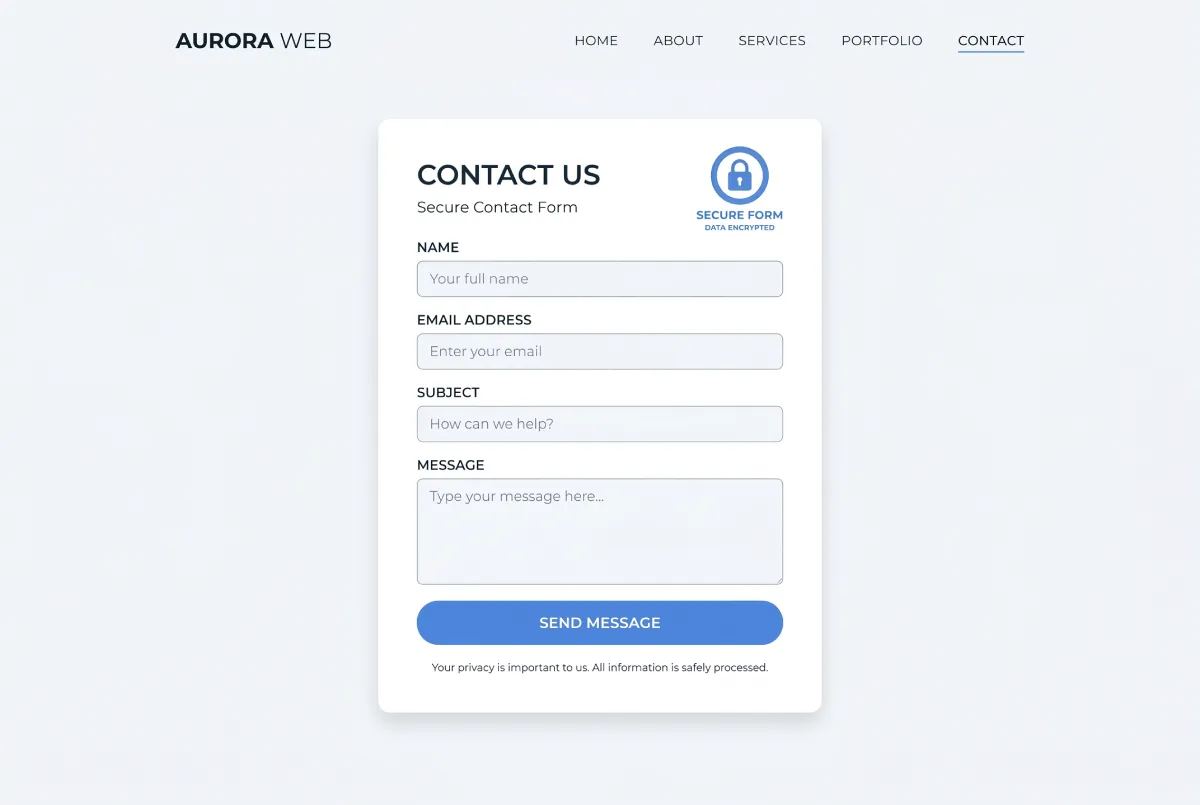
Here is where rules apply. If your contact form only asks for a name, an email, and a generic message (e.g., "I would like to schedule an appointment"), that alone does not constitute Protected Health Information.
If the form asks for diagnosis details, symptoms, or medical history, you enter restricted territory. The best practice remains simple: keep your contact form minimal. Ask only for the basic details needed to initiate a conversation.
The Email You Receive from the Form
This carries more risk. If a patient sends an email containing medical information, that email requires protection. You need an email provider that signs a Business Associate Agreement (BAA) with you and supports HIPAA compliance.
Standard Gmail fails this test. Specific versions of Google Workspace and other providers fully support HIPAA. This does not affect your site's design, but rather the communication infrastructure that follows.
Online Scheduling on Your Site
If your site features an online booking system that collects patient data, that system must be HIPAA compliant. Platforms like SimplePractice, TherapyNotes, and others are built specifically for mental health professionals and meet all compliance standards.
If you use these tools and simply embed them into your site, you eliminate the HIPAA risk at this stage. The dedicated platform handles the compliance.
Google Analytics and Tracking Tools
Many overlook this detail. Google Analytics collects visitor data. If a visitor is also a patient, and you can link that data to identify them and connect them to a therapy visit, you invite a HIPAA violation.
Practically, Google Analytics alone does not store medical data. However, if you run highly specific remarketing campaigns targeting past visitors as potential patients, you invite trouble. The golden rule: use analytics to improve your site, but strictly avoid remarketing campaigns targeting health-related audiences.
The Three Things You Must Do Immediately
1. Ensure Your Site Has an SSL Certificate
This is mandatory. A site running on HTTPS (instead of HTTP) encrypts the data transferred between the visitor's browser and your server. Every modern site requires this. If your site displays "Not Secure" in the address bar, fix it immediately.
2. Keep the Contact Form Simple
Never ask for sensitive medical information on your site's contact form. Name, email, phone number, and a brief message suffice. Discuss clinical details later through secure channels.
3. Use HIPAA-Compliant Tools Where Necessary
For emails containing patient data, use a provider that signs a BAA. For online scheduling, use a dedicated healthcare platform. For telehealth, use a HIPAA-compliant video service.
Which Tools Are HIPAA Compliant
Here are standard tool categories and their general compliance status. Always verify independently and request a BAA when necessary.
For Online Booking and Patient Records
Platforms like SimplePractice, TherapyNotes, and TheraNest are engineered specifically for therapists and guarantee HIPAA compliance. You simply integrate them into your site as external booking systems.
For Email
Google Workspace (with a BAA), Hushmail for Healthcare, ProtonMail for Business, and similar providers support HIPAA. The key is securing the signed BAA, not just using a secure platform.
For Telehealth
Standard Zoom is not HIPAA compliant out of the box. You need Zoom for Healthcare with a BAA, Doxy.me, VSee, or similar healthcare-specific video platforms.

What You Do NOT Need to Worry About
Misinformation heavily surrounds HIPAA and websites. Let's clarify what isn't a problem.
Your site's design has nothing to do with HIPAA. Colors, fonts, photos, layout. None of these trigger compliance issues.
Your site's content does not trigger HIPAA. If you write articles about anxiety, depression, or any specific condition, you remain perfectly safe. You publish general information, not patient data.
A simple contact form is not automatically a violation. If you request only basic contact details to start a conversation, you remain safely outside HIPAA territory.
Website hosting alone is not an issue unless you store medical records directly on the server.
The Practical Rule: Separate the Marketing from the Clinical
The simplest framework: your website is a marketing tool. Its sole purpose is to present who you are, what you do, and to prompt people to contact you.
Once someone becomes a patient, the clinical relationship begins. At that point, you switch to HIPAA-compliant tools: secure email, electronic health records (EHR), and compliant video platforms for telehealth.
Keep this boundary clear, and HIPAA compliance becomes highly manageable.
What a "HIPAA Compliant Website" Actually Means
When a web designer claims they build "HIPAA compliant websites," ask them what exactly they mean. The website itself isn't "audited" for compliance. How you handle patient data is what gets audited.
A website minimizes risk through smart architecture: SSL encryption, minimal contact forms, integration with compliant booking platforms, and zero remarketing tracking. That represents best practice. But the website itself carries no official HIPAA "certification."
The Questions You Must Ask Your Web Designer
When discussing your site with a web designer, ask these three questions:
First, do you force SSL encryption? (The answer must be yes, without hesitation.)
Second, does the contact form send data securely? What happens to that data?
Third, if I add online booking, is the platform you recommend built specifically for healthcare?
If the designer answers these clearly, you are in safe hands. If they stumble, they lack experience building sites for healthcare professionals.
The Real Reason HIPAA Should Not Stop You
Many therapists use HIPAA concerns as an excuse to delay building their website. "I don't know if it will be compliant, so I'll just wait." That is a trap.
Lacking a website does not protect you from HIPAA. It simply makes you invisible to prospective patients. And as we explained, HIPAA targets very specific data touchpoints, not the website as a whole.
Make the right decisions at the right touchpoints, and you build a website that operates as a powerful marketing asset while fully respecting HIPAA regulations.
The Bottom Line
HIPAA does not restrict your site's design or public content. It restricts how you handle patient data. A secure site (HTTPS), a minimal contact form, and the integration of compliant external tools for booking and communication cover your fundamental requirements.
For specific legal questions, always consult a healthcare attorney. But do not let these fears stop you from building a digital presence that properly represents your practice and brings the right patients through your door.
We Design Websites for Healthcare Professionals
At Evida Studio, we know exactly how to build sites for therapists and counselors. We ask the right questions and design a digital presence that performs flawlessly on every level.
Let's Talk